The short answer
What this means for you
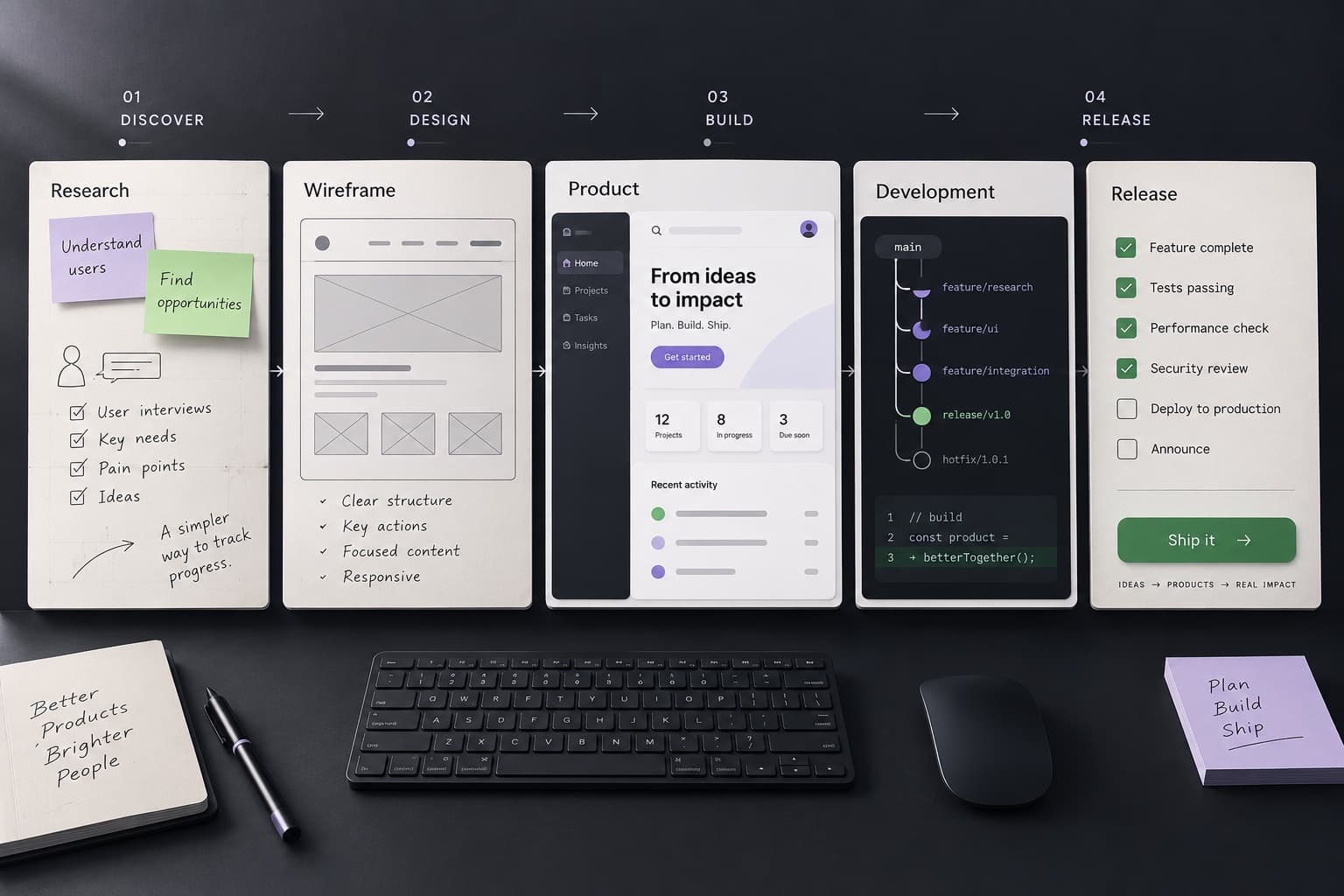
An MVP development process turns a product question into a small working release that real users can test. Define the user, task, expected result, and learning goal first. Then agree on scope, quality checks, ownership, and the decision that follows the test.
- Choose one complete user task before you choose features.
- Compare agency quotes against the same scope and acceptance checks.
- Plan support, data ownership, and release decisions before the first launch.
What should the MVP development process prove?
For a startup founder, an MVP should answer a product question before a larger investment. Write that question in observable terms. For example, ask whether a customer can request a booking without staff help. Avoid a goal such as build a modern platform.
The GOV.UK Service Manual starts discovery with understanding the problem before committing to a service build.[1]
Use that principle to separate research from delivery. Record the evidence you already have and the assumptions you still need to test. A prototype can test a confusing workflow before the team builds accounts, payments, and administration tools.
Choose a decision for the end of the release. You might continue, change the task, narrow the audience, or stop. Decide who owns that decision and what evidence they will review. A launch date alone does not answer the product question.
Use this MVP scope worksheet before you request a quote
Give every agency the same short brief. Name the user and the situation that causes them to act. Describe the starting point, important steps, successful result, and required support. Keep business assumptions separate from confirmed requirements.
For each feature, ask whether the user needs it to complete the chosen task. Move useful later features into a separate list. Record any manual work that remains, including the person who owns it. Manual work needs a defined process even when software does not automate it.
- User: who has the problem, and what do they do today?
- Task: what must they complete in the first release?
- Result: what observable event confirms completion?
- Dependencies: which accounts, data, services, and permissions must exist?
- Quality: which accessibility, performance, and failure checks must pass?
- Learning: what result will change the next product decision?
Worked example: a booking request MVP
Consider an illustrative booking service for a small operations team. The first release lets a customer request a time and lets staff confirm it. The example describes a planning method. It does not describe a Diffwise.app client or a measured project result.
The complete task needs a clear request form, server validation, a staff review path, and confirmation. A beautiful form without a usable staff process cannot complete that task. Automated scheduling and loyalty rewards can wait if the first test does not need them.
| Work item | Acceptance check | Later option |
|---|---|---|
| Booking request | A customer submits valid details and sees the saved request. | Saved customer preferences |
| Staff review | An authorized staff member accepts or declines the request. | Automatic team assignment |
| Confirmation | The customer can identify the final request status. | Calendar synchronization |
| Failure recovery | A repeated request does not create duplicate bookings. | Advanced operational reporting |
How do scope and uncertainty affect MVP cost?
Ask for an estimate that separates discovery, design, implementation, testing, and release work. Identify external charges separately. An estimate should state its assumptions, exclusions, review needs, and expected client inputs. Those details explain differences between proposals more clearly than one total price.
Request evidence for uncertain dependencies. For example, ask whether the existing booking API supports the required permissions and response states. A short technical check can identify work that a feature list hides. Record the result before you treat the estimate as a delivery commitment.
Diffwise.app does not publish a fixed MVP price or delivery guarantee. Its service pages describe product discovery, design, engineering, and release planning. Share the scope worksheet to discuss a suitable first project. Compare any proposal against the same defined task.
Keep essential quality work inside the first release
W3C recommends involving people with disabilities in web projects to improve accessibility.[2]
Include representative users when you review the main task. Check keyboard access, readable content, focus, touch controls, and error messages. Decide which devices and conditions matter to the first audience. A smaller scope should reduce feature count rather than hide known access barriers.
Define account permissions, validation, monitoring, backup needs, and recovery before release. Test the main failure paths as complete tasks. A customer should know whether a request succeeded and what action remains available. Give support staff enough information to resolve a failed attempt.
What should you ask an MVP development agency?
Ask who owns the whole user task across design, frontend, backend, and release. Request one relevant project and a clear account of the agency role. Separate a live product link from evidence about delivered scope. Ask for approved results when results matter to your decision.
Request a demonstration plan for each delivery milestone. The plan should show working behavior, known limits, open decisions, and the next review. Confirm who controls source code, hosting accounts, product data, and operational access. Record the handover work in the project scope.
- What evidence supports the proposed first release?
- Which assumptions can change the estimate?
- What will a milestone demonstration prove?
- Who resolves a blocked dependency or product decision?
- What support and handover work does the proposal include?
How should you measure the first release?
Measure whether users complete the chosen task and where they need help. Record failed attempts and support reasons alongside completed tasks. Compare the result with the original learning goal. A large visit count cannot replace evidence about a small task that users cannot finish.
Review the results with the decision owner. Update the scope only when the evidence supports the change. Keep a short decision record with the observation, proposed action, owner, and next check. This record gives the next release a reason beyond adding more features.
MVP development questions before you start
How long does an MVP take? The answer depends on scope, dependencies, review needs, and release conditions. Ask for a milestone plan after discovery. Check the assumptions behind a public delivery claim. Treat the claim as a supplier statement, rather than your project promise.
Can you start with an existing codebase? Yes, a first project can assess the current journey and technical constraints. Ask the team to identify what can remain and what needs evidence before it changes. Do not assume that a complete rebuild provides the best first test.
What comes after the MVP? Use the agreed learning goal to choose the next release, a focused correction, or a pause. Start the conversation with a clear brief and one complete task. That gives an MVP development agency a useful basis for scope and review.
Sources and further reading
- How the discovery phase worksGOV.UK Service Manual · Checked 2 November 2026
- Involving users in web projects for better accessibilityW3C Web Accessibility Initiative · Checked 2 November 2026