
The short answer
What this means for you
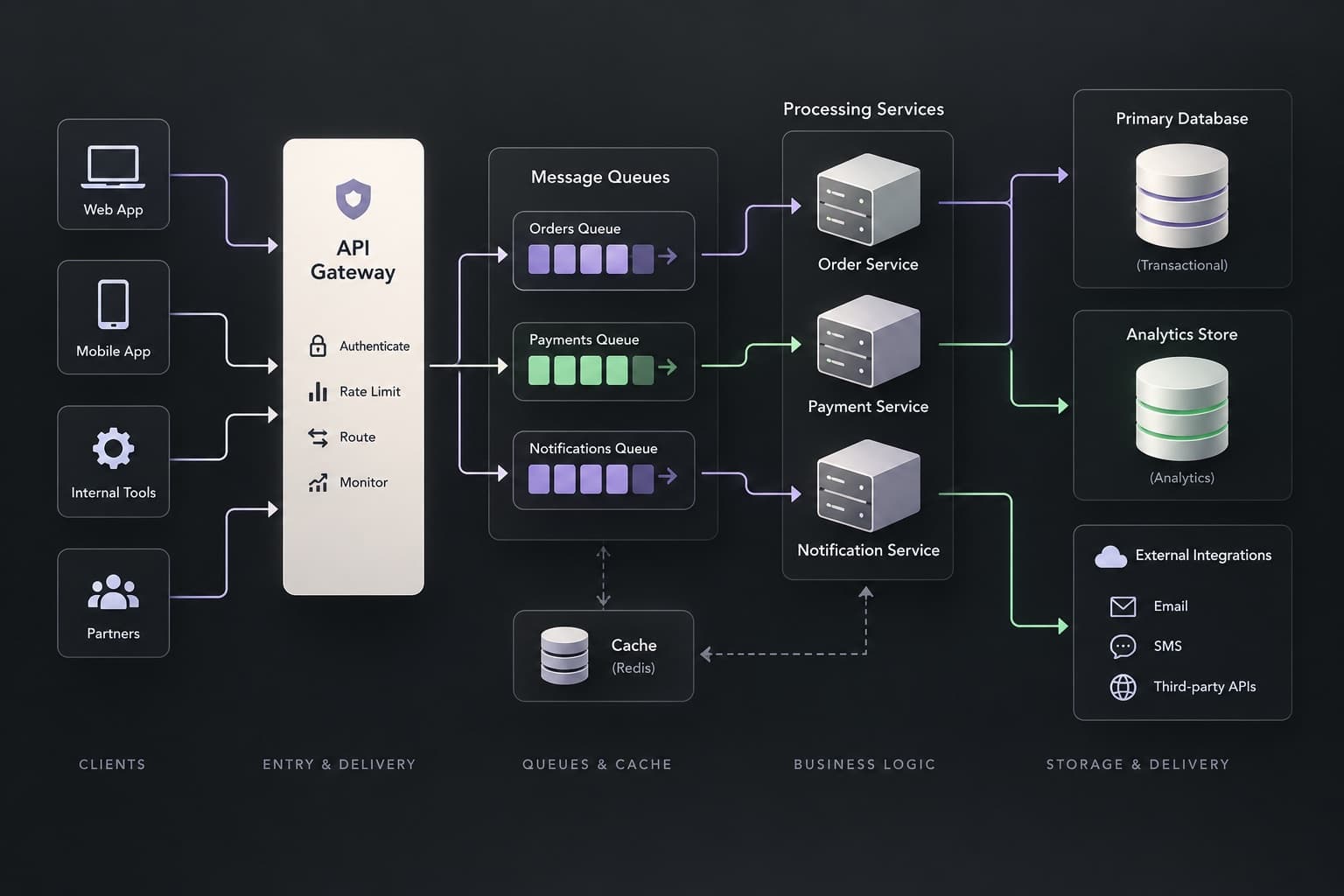
An API integration requirements document records the business task, systems, data owner, access, failure behavior, and release evidence in one place a developer can estimate from. Start with the business action. Then test successful, delayed, repeated, and failed requests, and name who resolves mismatched records.
- Define which system owns each record before choosing the connection method.
- A timeout can leave the result unknown. Check the provider behavior before retrying.
- Include reconciliation and operational ownership in the integration scope.
Start the API integration checklist with one business task
This guide helps business owners and product teams prepare an integration brief. An API lets software request information or actions from another system. The project must define what happens before, during, and after that request. A successful connection test alone does not establish a complete customer task.
Describe the trigger, expected action, and visible result. For example, a confirmed order creates one fulfillment request. Define what the customer sees while the request remains pending. Name the person who investigates an order that never reaches fulfillment.
Keep the first connection small enough to demonstrate. Include the real permissions and failure behavior in that demonstration. Move optional fields and secondary actions into a later scope. This boundary gives the team a useful estimate and a clear acceptance test.
Which system owns each record?
Create a field map before implementation. Record the source field, destination field, format, allowed values, and update direction. Decide which system controls the final value when records differ. Use sample records without private customer details during the first review.
Document identifiers that connect records across systems. Include rules for missing values, deleted records, and changed account details. Treat an old record import separately from ongoing updates. An integration can need both, with different checks and recovery steps.
| Decision | Example agreement | Acceptance evidence |
|---|---|---|
| Trigger | A confirmed order starts fulfillment. | A draft order creates no fulfillment request. |
| Record identity | Keep the order ID beside the fulfillment reference. | Support can locate both records from one order. |
| Data owner | The commerce system owns the delivery address before dispatch. | An address change follows the agreed update rule. |
| Pending result | Show a processing state until confirmation arrives. | A delayed response does not appear as confirmed fulfillment. |
| Recovery | An operations owner reviews unresolved requests. | The owner can reconcile the request without creating a duplicate. |
What goes in an API integration requirements document?
An API integration requirements document is a short written brief that tells a developer what to connect, why, and how you will accept the result. It is not the API's own reference documentation. It sits in front of it and records the decisions only your business can make: the task, the data owner, the access rules, and the failure behavior.
Two to four pages is enough for one integration. Attach the provider's public documentation and a few sample records rather than copying them in. Mark each line with who supplies the answer, so gaps are visible before anyone quotes.
The OpenAPI Specification defines a standard, language-agnostic interface description for HTTP APIs that both people and software can read. If the provider or your own backend publishes an OpenAPI file, attach it. If you are exposing an API yourself, ask the developer to deliver one as part of the work.[3]
For authorization, RFC 6749 describes OAuth 2.0 as a framework that lets an application obtain limited access to an HTTP service. For a client acting on a user's behalf, RFC 9700, the current OAuth security best practice (January 2025), recommends the authorization code grant with PKCE. It says the resource owner password credentials grant must not be used and that clients should not use the implicit grant, so do not accept either in a requirements document.[5][7]
For system-to-system access with no user present, ask for the client credentials grant, and record who approves access and which scopes the service account gets. If the device cannot open a browser, ask whether the provider offers the device authorization grant. If the provider supports only a grant that RFC 9700 advises against, record that as a risk to review before you build.
For repeated requests, RFC 9110 says PUT, DELETE, and safe methods are idempotent, so a client can repeat them automatically if a connection fails before the response arrives. It does not give POST that property, so write down how each create action avoids duplicates.[6]
For error responses, RFC 9457 defines a machine-readable problem details format, sent as application/problem+json. If you control the API, ask for it in the requirements. If the provider uses its own format, record that format and its error codes.[8]
For security review, the OWASP API Security Top 10 (2023) lists risks such as broken object level authorization, broken authentication, unrestricted resource consumption, and unsafe consumption of APIs. Use the list as a review prompt, and ask the developer which risks apply to each endpoint in scope.[4]
- Template outline, section 1: Purpose. One paragraph on the business task, the trigger, and what the user sees.
- Section 2: Scope. What is in the first release, and what is deferred.
- Section 3: Systems and owners. Each system, its account owner, and a contact.
- Section 4: Data. The field map, identifiers, update direction, and which system wins a conflict.
- Section 5: Access. Authentication method, permissions, test and production accounts, and how credentials are shared.
- Section 6: Behavior. Expected volumes, limits, retry rules, duplicate handling, and error format.
- Section 7: Security. Which risks from the OWASP list apply, and how each will be checked.
- Section 8: Acceptance. The failure-case checks, test data, and the person who signs off.
- Section 9: Operations. Monitoring, alerts, reconciliation steps, and who maintains the integration after release.
- Section 10: Open questions. Each unresolved dependency with an owner and a date.
| Field | Example | Who supplies it |
|---|---|---|
| Purpose and business task | A confirmed order creates one fulfillment request. | Business owner |
| Systems and owners | Shop platform (source), fulfillment provider (destination), named contact for each. | Business owner |
| Provider documentation | Link to the public docs and any OpenAPI file. | Provider, found by the developer |
| Data fields and direction | Order ID, address, line items; one-way from shop to provider. | Business owner and developer |
| Authentication and permissions | OAuth 2.0 client credentials; one service account with the minimum scopes. | Provider and developer |
| Volumes and limits | Expected requests per day, provider rate limits, peak times. | Business owner and provider |
| Error and retry behavior | Show pending after a timeout; check status before retrying a create. | Developer, agreed by business owner |
| Security requirements | Endpoints reviewed against the OWASP API list; secrets held outside the code. | Developer |
| Test environment and sample data | Provider sandbox with synthetic orders; no real customer data. | Provider and business owner |
| Acceptance evidence and owner | Seven failure-case checks passed; named person reconciles mismatches. | Business owner |
Confirm account access and test conditions
List the provider accounts, permissions, approval steps, and test environments that the connection requires. Confirm who controls each account. Keep test and production configuration separate. Share credentials through the agreed access system, rather than pasting them into the project brief.
Check whether the test environment supports the exact actions your project needs. Record differences from production behavior. Confirm request limits and restrictions against the selected provider documentation. Give each unresolved dependency an owner before committing to a release date.
What happens when a request times out?
A timeout can occur after the remote system accepts an action. Treat the result as unknown until the integration can establish its state. Define whether the team checks a request identifier, waits for an event, or asks an operator to reconcile it. Avoid treating every timeout as permission to repeat an action.
Stripe documents idempotency keys for supported create and update requests. These keys help clients repeat a request without creating the same operation twice. The documented behavior depends on the API version.[2]
For your chosen provider, verify which actions support this protection. Agree on request identity, retry limits, waiting periods, and an escalation path. Test repeated requests against the same business operation. Include an outcome check that confirms the expected record exists exactly once.
Plan duplicate and delayed webhook events
A webhook delivers an event from another system to your application. Stripe states that its webhook events can arrive more than once and outside their generation order. Stripe also documents event signature verification.[1]
Use those documented conditions as review questions for the provider you select. Decide how the receiver verifies the sender and recognizes processed events. Define which events can change the business record. Record what happens when an older event arrives after a newer state.
Give operators a way to find delayed or failed work. An accepted event does not prove that every later task completed. Trace the event through the final customer result. Test recovery from a stopped worker or unavailable dependency before releasing a critical connection.
Use failure cases as acceptance checks
Agree on these checks with the receiving team. Use an approved test environment and synthetic records. Save the expected result beside each observation. Keep a separate list of provider behavior that the test environment cannot reproduce.
When the connection adds an AI feature, include retrieval permissions, evaluation cases, and usage limits in the integration brief.
- A valid request reaches the expected final business state.
- An invalid field produces an understandable correction.
- A repeated request does not create duplicate work.
- A delayed response leaves a clear pending state.
- An expired permission produces a visible operational alert.
- An interrupted event can recover through the documented process.
- A support owner can reconcile records across both systems.
API integration questions before you request a quote
What affects API integration cost? Scope depends on data mapping, access, provider limits, failure handling, testing, and ongoing operations. Supply example records and the expected business result. Separate the initial connection from migration and support. Request an estimate that identifies assumptions and unresolved provider dependencies.
Can an existing backend support a new app? Yes, if its contracts and permissions support the required tasks. Start by checking its data model, permissions, response states, and supported operations. Demonstrate one complete app task against the existing API. Record required backend changes before estimating the remaining screens. A list of available endpoints does not establish that every task works.
What should an integration agency receive first? Share the task, current systems, public provider documentation, example records, and required result. Identify the business owner and access dependencies. Use this API integration checklist to prepare the brief. Provide private access only through the agreed project process.
What are the stages of an API integration? A common sequence is scoping the business task, reading the provider documentation, agreeing the data and access rules, building against a test environment, testing failure cases, releasing, and operating it with monitoring and reconciliation. The requirements document covers the first four. Order and names vary between teams.
How do you document an API integration? Keep the requirements document as the decision record, attach the provider documentation and any OpenAPI file, and update both when behavior changes. For a rough sense of the wider project cost, use the free software project estimator before you request quotes.
Sources and further reading
- Receive Stripe events in your webhook endpointStripe · Checked 2 November 2026
- Idempotent requestsStripe · Checked 2 November 2026
- OpenAPI SpecificationOpenAPI Initiative · Checked 18 November 2026
- OWASP API Security Top 10 2023OWASP · Checked 18 November 2026
- RFC 6749: The OAuth 2.0 Authorization FrameworkIETF · Checked 18 November 2026
- RFC 9110: HTTP SemanticsIETF · Checked 18 November 2026
- Best Current Practice for OAuth 2.0 Security (RFC 9700)IETF · Checked 18 November 2026
- RFC 9457: Problem Details for HTTP APIsIETF · Checked 18 November 2026